Getting Behind the Label - Germany
German wine has a bad reputation, at least in the UK, with people associating it with the sweet styles (Liebfraumilch) that flooded the market in the ‘70s and ‘80s. However, Germany is a massive country with a rich and varied wine heritage, so it is definitely worth giving it a second chance!
But if you’re looking for a specific style, where do you start? The labelling terminology is unfamiliar and hard to remember (unless, like me, you’re a fan of the excellent compound words that the German language provides!) and you are unlikely to find any tasting notes or sweetness level on the bottle.
The one thing you will see on the bottle is the grape variety…but even that can be confusing, as the grapes are often local grape varieties (e.g., Dornfelder) or unfamiliar names for well-known international varieties (e.g., Spätburgunder rather than Pinot Noir).
In this article, I’ll provide you with some simple pointers to help start your German wine odyssey!
The Historic German System – Prädikatswein System
First, it’s important to understand Germany’s historic wine ‘quality indicators’, as this helps unpick why German wine labelling is so different to other countries.
Germany is generally a cold country (in wine terms) with a ‘continental’ climate. That means that while it has relatively low average temperatures, there is a large temperature gap between its warm, fairly short summers and cold winters. This makes it harder for the grapes to ripen, so only the best sites would historically have been able to produce fully ripe grapes with high sugar content.
Labelling terminology reflects this. The German ‘Prädikatswein’ labelling system (the equivalent of AOC in France or DOC in Italy and Spain) focuses on how much sugar is in the grapes: the more sugar in the grapes, the riper they are, and so must have come from the best sites. This doesn’t necessarily mean that the wine is sweeter, although there does tend to be a correlation.
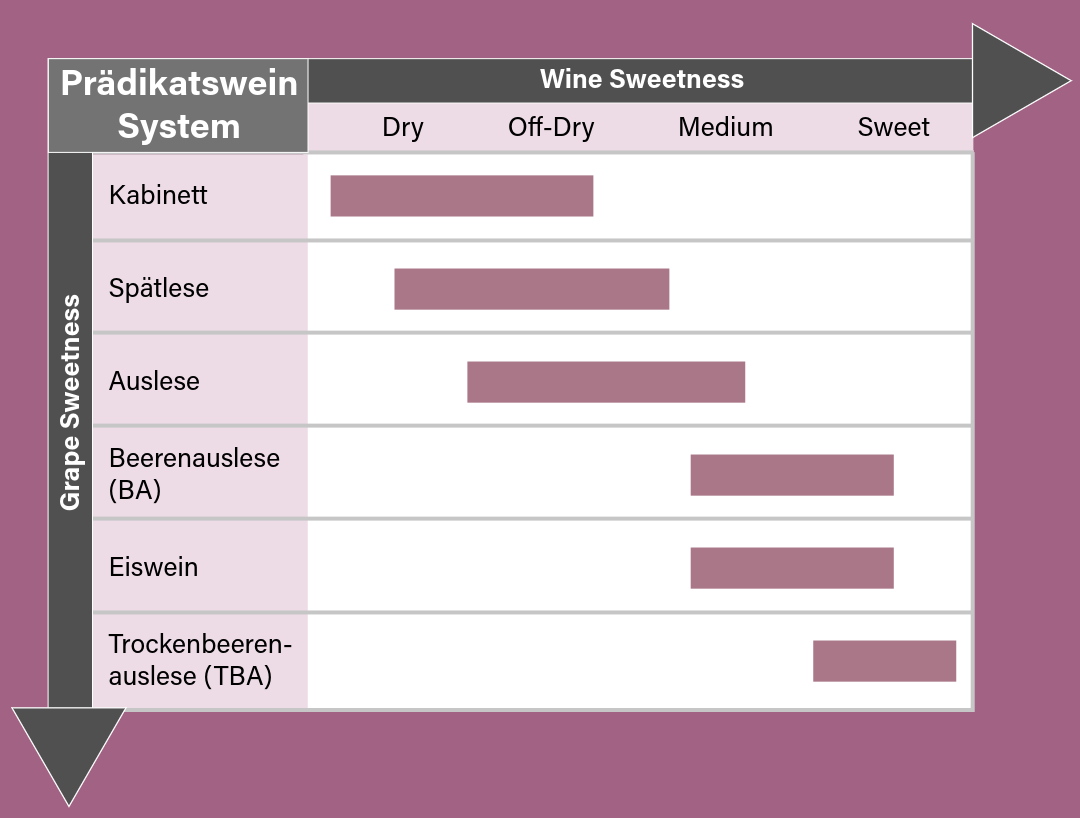
The lower end of this scale tends to produce dry to off-dry wines, depending on whether the winemaker decides to fully complete fermentation or stop it early to retain some sugar in the wine. At the top end of the Prädikatswein system, the grapes are so sweet that the yeast tends to get overwhelmed by sugar and fermentation is slowed or stopped naturally.
The Prädikatswein label, and the lower classification ‘Qualitätswein’, guarantees that the grapes were grown in the specified region, using specific grapes and winemaking methods. This prevents the use of additives. Qualitätswein can include a small amount of added sugar to help the fermentation process, whereas winemakers producing Prädikatswein have to make do with what they can get naturally from their grapes!
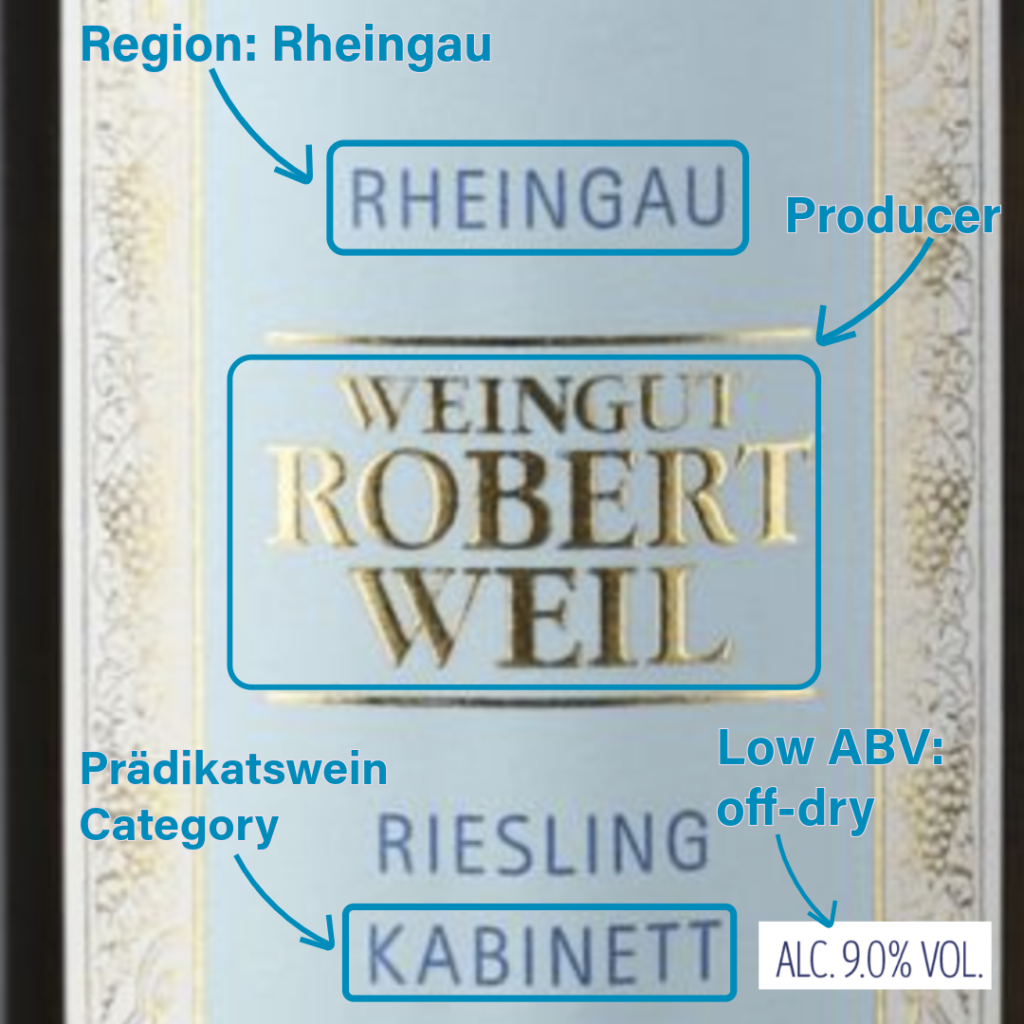
Here's an example of an off-dry style Kabinett Riesling from the Rheingau region - and how I've used the alcohol content on the back of the bottle to spot that it's off-dry:
A More Modern System – VDP
Some German winemakers have focused on producing wine in a style to appeal to the global market, focusing on high quality wine production. The Verband Deutscher Prädikatsweingüter (“VDP”) was established in 1910 as a trademark for outstanding German wines, adopting the French system of ‘Premier Cru’ and ‘Grand Cru’ to indicate quality. However, this was not widely included on labels until 2012. It represents a consortium of like-minded, quality-focused winemakers.
If you see the VDP logo – an eagle & bunch of grapes – you know you’re onto a winner, but here is a quick breakdown of the classification you’ll see alongside the logo.
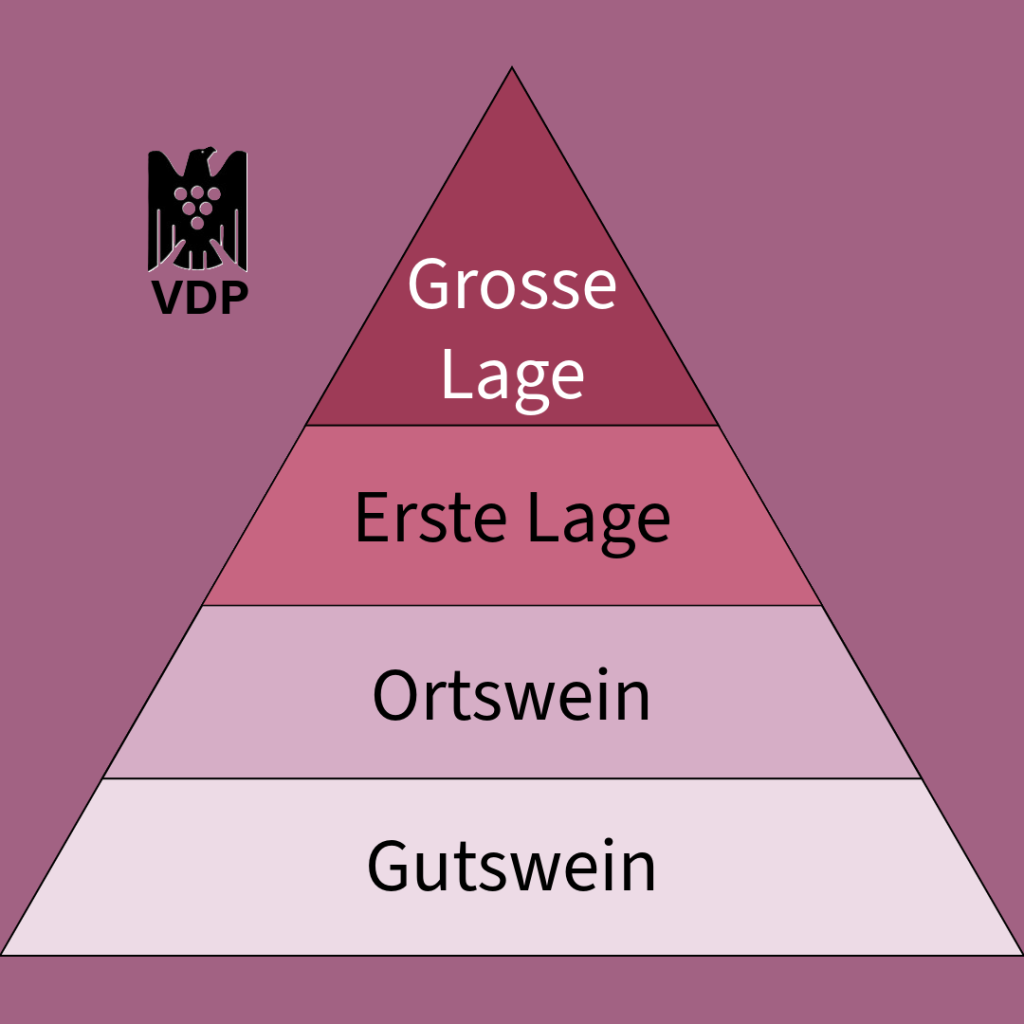
- “Grosse Lage” (literally ‘great location’) is reserved for the absolute best of German wine. Dry wines will also be labelled “Grosses Gewächs” (‘great growth’) or GG.
- “Erste Lage” (‘first location’) indicates a first-class German wine. Dry wines will also be labelled “Erste Gewächs” (‘first growth’) or 1G.
- “Ortswein” are wines that are often produced from grapes grown in an Erste Lage or Grosse Lage vineyard, giving you a more affordable way to experience a great winery.
- “Gutswein” is an entry level wine which is still good quality but doesn’t have to follow the same strict rules as the top classifications, so you’re likely to find more variety here.
Sweet wines at all VDP levels will also include the Prädikatswein labelling term (e.g., Auslese) so you have an idea of the sweetness level. If it doesn’t, expect a dry wine.
Changes on the horizon
From the 2026 vintage, Germany is ringing in the changes! To address the confusion that German wines sometimes receive, Germany is adopting the PDO system (aligned to much of the rest of Europe) to make the definition of wine labels easier to follow. This clarifies the distinction between wines produced from a single region from those produced from a single vineyard. This will replace both the VDP and Prädikatswein system, but it is likely that those terms will remain in use to preserve tradition.
From 2026 vintages, you will see a Region label (e.g., Rheingau), similar to the French AOC system. The regional label will dictate what grapes and winemaking styles can be used. Wines produced from a single vineyard will bear a three-tier classification which is similar to the VDP classification:
- Grosse Lage ('great location') - representing the best vineyards. Wines made from grapes grown only in a Grosse Lage vineyard can put this on the bottle. Grosses Gewächs / GG will still be used to indicate dry wines.
- Erste Lage ('first location') - awarded to very good vineyard sites. Wines must be made from grapes grown in an Erste Lage vineyard. Erstes Gewächs / 1G will still be used to indicate dry wines.
- Einzellage ('one location') - classification for single vineyard wines which are not Erste or Grosse Lage classified.
This may well be another layer of complexity to remember, but if you're looking for a particular style, there are a few tricks you can keep in mind...
How do I spot a dry German wine?
If you are looking for a dry style, here are a few things to look out for:
- A higher alcohol level (over 10%) gives you a rough indication that a wine will be a drier style. Fermentation converts sugar to alcohol, so a high ABV implies that most (if not all) sugar has fermented out.
- The term trocken appears on the label, which means ‘dry’. Caution – don’t confuse this with ‘trockenbeeren’, meaning ‘dried berries’, otherwise you’re in for a super sweet surprise!
- You see either GG or 1G on the bottle. These wines are likely to be expensive, but expect a superb dry German wine.
- A very small handful of producers will include a sweetness indicator on the back of the bottle, showing you whether the wine is Dry/Off-Dry/Medium/Sweet.
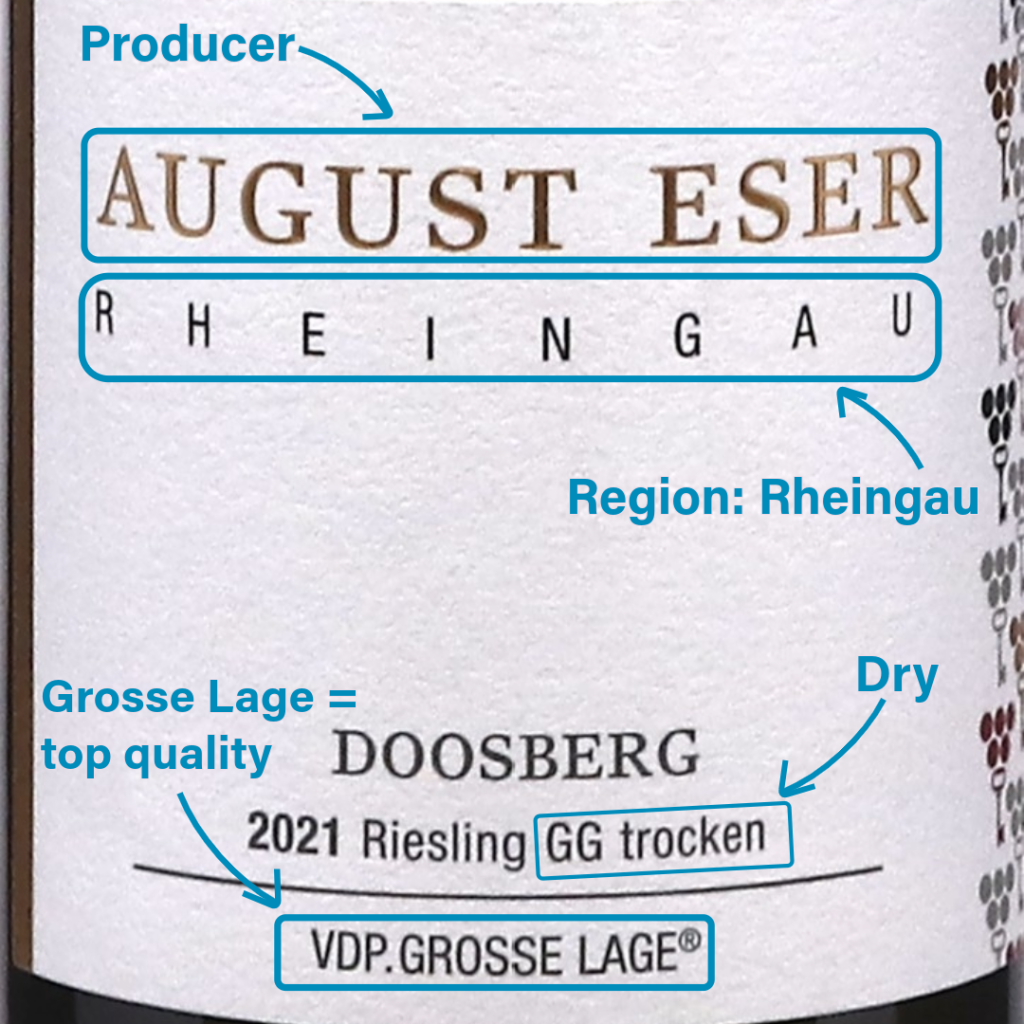
Here's an example of a Grosses Gewächs Riesling from the Doosberg vineyard in the Rheigau region, which we know will be dry in style due to 'GG' and 'trocken' appearing on the label. If we were in doubt, when we check the back of the bottle and see an ABV of 12.0% we know this should be dry!
And what if I’m after a sweet wine?
Germany has got you covered! German sweet wines are amongst the best in the world, partly due to their high acidity which helps counterbalance the high sugar levels. Look for lower ABV wines and learn to recognise the higher levels of the Prädikatswein system.
Beerenauslese (BA), Eiswine (Icewine) and Trockenbeerenauslese (TBA) will all be very sweet dessert wines, typically made from Riesling, but with refreshing acidity. They tend to carry a fairly hefty price tag unfortunately, as the vineyard conditions have to be just right and so are not produced every year.
If you look lower down the Prädikatswein categories, you can find good value off-dry to medium-sweet wines which make brilliant pairings for intensely-flavoured spicy savoury dishes, as the sugar works to soften chilli heat. A Riesling Auslese, for example, makes a fantastic partner for Korean BBQ food!
Where next?
If you’re a convert to German wine, why not pay Austria a visit? Once you’ve mastered German wine terminology, you’ll notice a lot in common between these two regions. Austrian wine also tends to be slightly more affordable.
Stick with me to continue your journey through the Old World of wine!
Glossary
Local Names for Common International Grapes
- Grauburgunder – Pinot Gris / Pinot Grigio (literally ‘gray Burgundian’)
- Schwarzriesling – Pinot Meunier (‘Black Riesling’)
- Spätburgunder – Pinot Noir (‘late Burgundian’)
- Weissburgunder/Weißburgunder – Chardonnay (‘white Burgundian’)
German Wine Terms
- Auslese – third stage of the Prädikatswein system. Likely to be at least slightly sweet and intensely flavoured.
- Beerenauslese (BA) – fourth stage of the Prädikatswein system. Likely to be sweet and concentrated, usually drunk as a dessert wine.
- Einzellage – new from 2026 vintage, meaning a single vineyard wine.
- Eiswein (ice wine) – fifth stage of the Prädikatswein system. Grapes are as ripe as Beerenauslese but these are left to freeze on the vine, concentrating the flavours and sugar to make sweet styles. Such wines are rare, particularly given temperature increases due to climate change.
- Erste Gewächs (1G) – ‘first growth’ wines, indicating excellent quality, dry style wines.
- Erste Lage – second-highest tier of VDP system, indicating an excellent wine from selected vineyard sites. May be accompanied by 1G label to indicate a dry wine or a Prädikatswein label term to indicate sweetness level.
- Feinherb – made in an off-dry style, slightly sweeter than Halbtrocken.
- Grosse Gewächs (GG) – ‘great growth’ wines, saved for the highest quality dry style wines that Germany has to offer.
- Grosse Lage – fourth and top tier of the VDP system, reserved for a wine produced from a top vineyard site. Indicates an outstanding wine. May be accompanied by GG label to indicate a dry wine or a Prädikatswein label term to indicate sweetness level.
- Gutswein – lowest tier of VDP system, guaranteeing a quality wine that will be dry unless you see a Prädikatswein label too. Similar to French ‘regional’ appellation (e.g., Côtes-du-Rhône).
- Halbtrocken – made in an off-dry style.
- Kabinett – first stage of the Prädikatswein system. Usually indicates a light, low-alcohol style. Usually dry or slightly sweet.
- Landwein – entry level wine, but with regional protection (guaranteeing the wine comes from grapes grown in the stated region). Usually dry or off-dry, simple wines.
- Ortswein – second lowest tier of VDP system, guarantees a very good wine (often from top vineyard sites) that will be dry unless you see a Prädikatswein label term. Similar to French ‘villages’ appellation (e.g., Chablis).
- Prädikatswein – denoting a high quality wine from a recognised region with strict production rules. Unlikely to see this on the label, but rather the associated sweetness level (e.g., Auslese).
- Qualitätswein – denoting a quality wine from a recognised region.
- Sekt – sparkling wine, often slightly sweet. Usually made in the same style as Prosecco, the better Sekt may be made in the traditional (Champagne) method. “Sekt bA” and “VDP Sekt” indicate higher quality, usually dry, sparkling wines.
- Spätlese – second stage of the Prädikatswein system. Usually indicates a ripe, more intense style. Usually dry or slightly sweet.
- Trocken – a dry wine.
- Trockenbeerenauslese (TBA) – sixth and final stage of the Prädikatswein system. Intensely sweet, rich wines which can age for decades. These wines are only produced in the best years.
- VDP – denoted by the eagle and grapes logo, the ‘new’ German classification system. Means the wine is usually dry (unless accompanied by a Prädikatswein label term).