
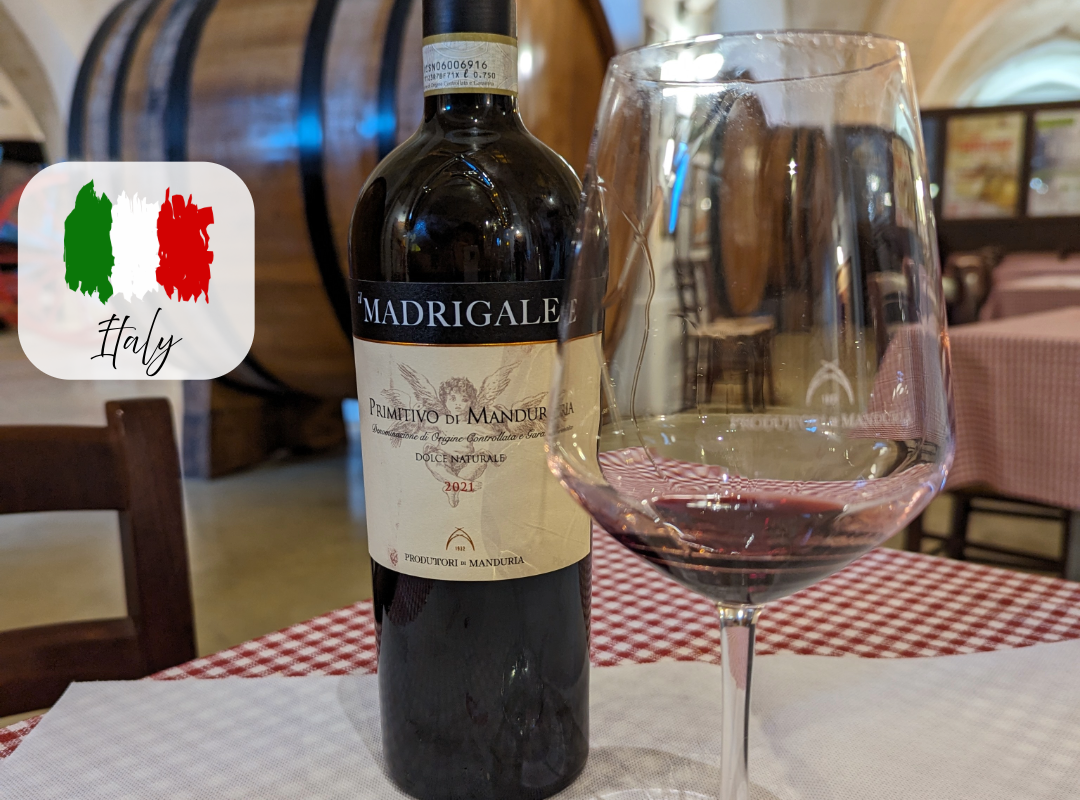
Getting Behind the Label - Italy
Italy has an exceptionally long history of winemaking. Vines are believed to have been brought into mainland Italy by the Phoenicians around 1,000 years BC, although there is evidence of vine plantations in Sicily dating back 3,000 years earlier!
The Roman Empire really industrialised Italy’s wine production, and introduced an early precursor to the PDO / appellation system: Roman wine could only be produced within Italian borders, and was supposedly sought after in neighbouring countries (Gaul, modern-day France, being one of the Empire’s biggest markets).
After the fall of the Roman Empire much of Italy’s vineyards fell into disrepair or were repurposed. The burden of winemaking fell, as is so common across Europe, onto the shoulders of the Catholic church – this became a good revenue stream for monasteries scattered across the country. Italy has a huge diversity of styles across the country, and winemaking terminology has evolved slightly differently across its various provinces. It wasn’t until the 1960s that formal ‘Protection of Origin’ rules were introduced – thirty years or so behind the French appellation system – at which point the historic rules of each wine region became more formalised.
Land and vine
Like France, Italian wine labelling focuses around the region, although there is less of a hierarchy in terms of regions and sub-regions. Unlike France, Italy’s most premium wine regions will occasionally include the name of the grape in the appellation!
Italy has a phenomenal number of native grape varieties – over 350 varieties authorised for use in wine production – and there is a lot of pride in producing wines with varieties that are all but impossible to find anywhere else in the world, hence grapes are often recognised in the appellation.
Whilst you may not have heard of many of the grape varieties that you’ll read about in this article, the wines they produce to are likely to be familiar. For example, few people have heard of the grape variety Glera, but you’d be hard pressed to find a person who hasn’t tried Prosecco!
DOC system
The principal mark of quality in Italian wine is Denominazione di Origine Controllata (‘DOC’), indicating that the wine is made from grapes grown in the stated region and following specific winemaking rules. Denominazione di Origine Controllata e Garantita (‘DOCG’) typically indicates more prestigious wine regions. This is usually regional (certain regions designated as better quality than others) but occasionally you will find a DOCG covering the same region as a DOC, with a higher standard of production.
IGT/IGP (Indicazione Geografia Tipica/Protetta) indicates a generic regional appellation, meaning that grapes must be grown within the stated region, with few other rules to follow. These are generally lower-quality, ‘everyday’ wines – though some top producers may use the IGT label to produce premium wines from grape varieties that wouldn’t be allowed in a DOC/DOCG.
Entry-level wine will be labelled Vino di Tavola (‘VdT’, literally ‘table wine’) and will have even less regulation than an IGT wine – including allowing blending grapes from different regions.
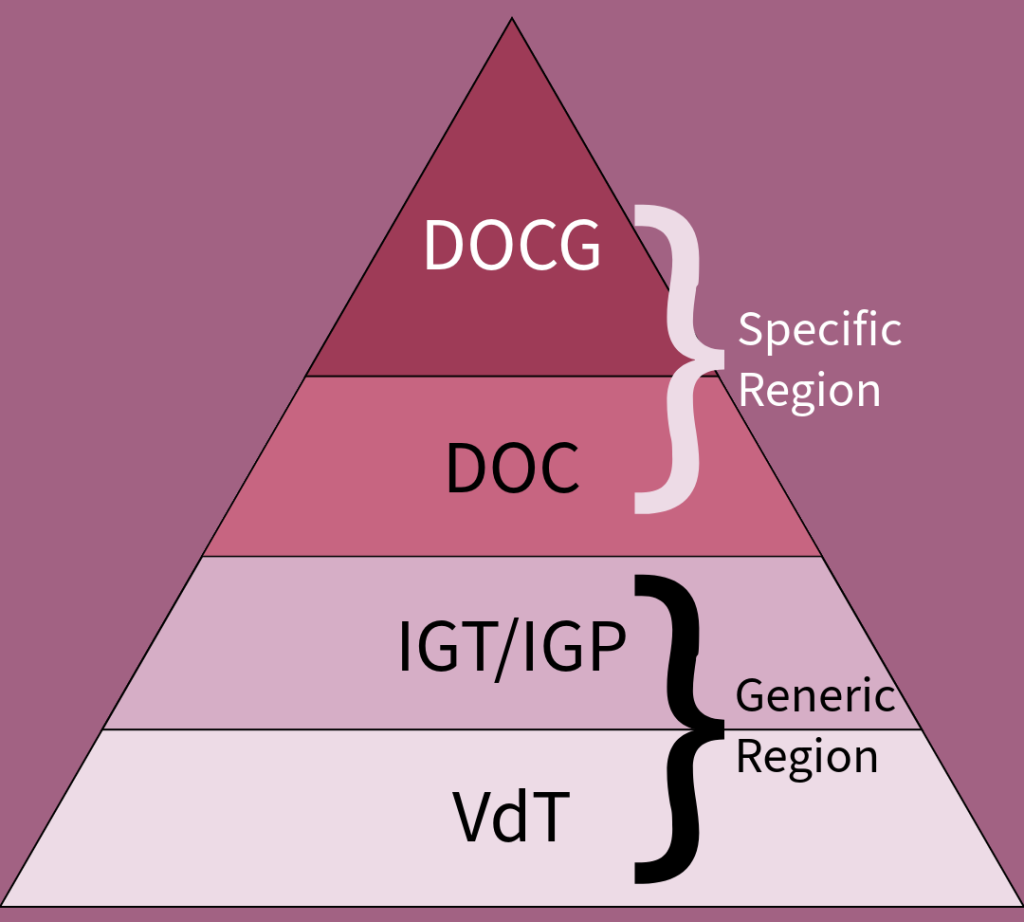
For example, a wine produced within Tuscany could be labelled ‘IGT Toscana’, provided the grapes are grown within the region. If you grow Sangiovese grapes in a particular region around the Tuscan town of Montalcino, and meet the other winemaking requirements, you could label this wine ‘Rosso di Montalcino DOC’. If you were to age this wine for longer in oak barrels, you might be able to label it ‘Brunello di Montalcino DOCG’, being a more prestigious mark of quality. In this case the DOCG label tells you which grape is used in production – Brunello being the local name for Sangiovese.
Navigating Italy’s wine regions
Italy, as we know it today, is a relatively young country: until the mid-19th Century it was a collection of independent kingdoms and states, and only unified in 1871. This, alongside the difference in climate and geography across the country, perhaps explains the diversity in wine production and winemaking styles. Parts of the north were under the rule of the Austrian Empire for many years, so you’ll even see Austrian/Germanic grape varieties like Gewürtztraminer and lots of Germanic labelling terms!
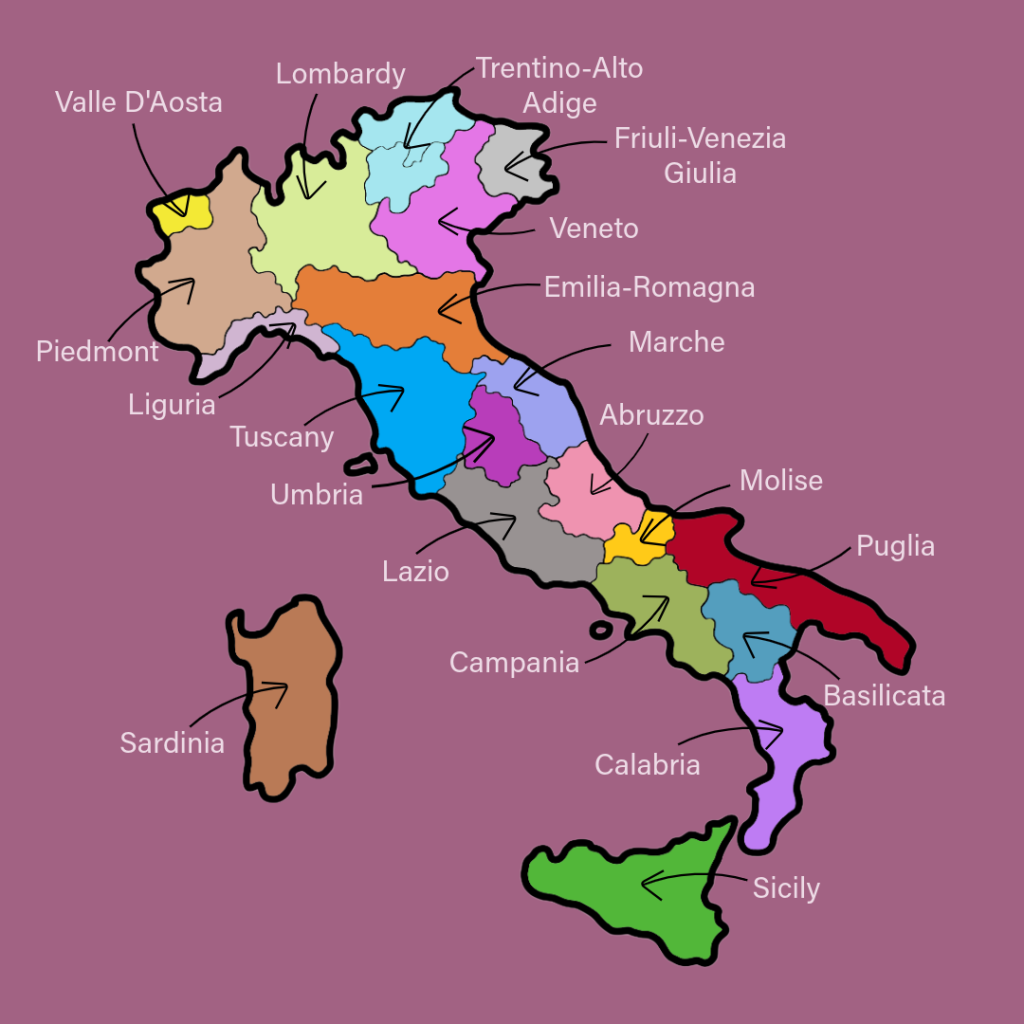
Italian producers often take pride in working with local grape varieties, so if you find a grape variety that you like in one region, you may struggle to find it elsewhere in Italy. Take the Montepulciano grape for example – it generally makes good, straightforward fruity red wines that are often fairly cheap. However, you are unlikely to find this grape variety in the north of Italy as the climate is too cold, or too far south as it can get over-ripe.
So, even if you learn specific Italian grape varieties that you like, if you’re dropped into a completely different region how do you know which bottle to reach for?
A good rule of thumb is that the warmer the region, the fruitier and heavier the wine is likely to be – so the North tends to produce lighter styles. The inverse is true when it comes to complexity, with Southern Italy tending to produce more simple, easy-drinking styles. This is a broad generalisation, but it’s worth learning the name of specific regions you like – if you like Chianti (a wine region within Tuscany) then the chances are high that you will like other Tuscan wines.
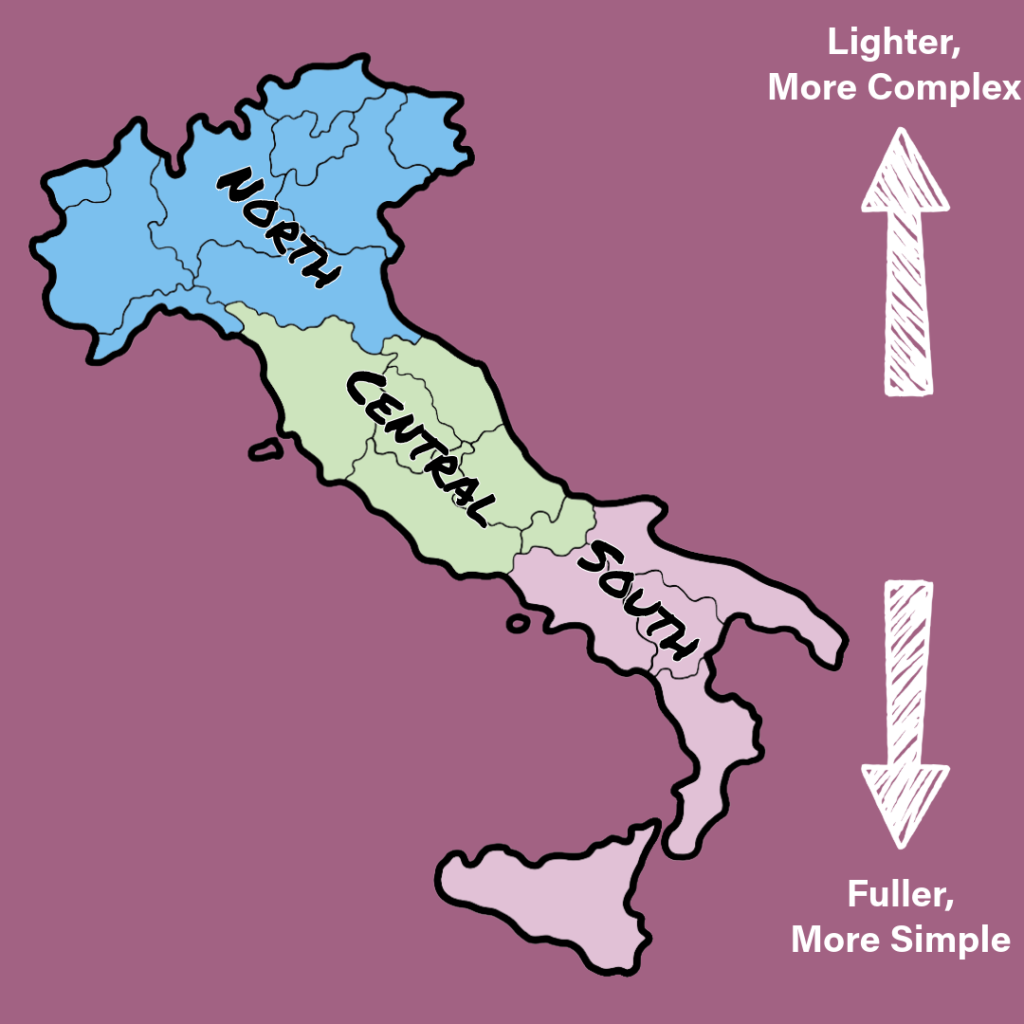
Here’s a quick rundown of the major wine regions, their famous cities, and what to expect from them:
North Italy
Northern Italy has a cooler climate than the rest of the country, and much of the winegrowing here is clustered in the foothills of the Alps. You’re likely to see more elegant, higher acidity red and white wines produced here. Major regions include:
- Lombardy (Milan, Como, Garda) is best known for Franciacorta DOCG, sparkling wines made in a traditional method from Pinot Nero (Pinot Noir) and Chardonnay – both Champagne grapes.
- Piedmont / Piemonte (Turin) is famous for its age-worthy, elegant and savoury red wines. Barolo DOCG and Barbaresco DOCG are the ‘big names’, made from the Nebbiolo grape. If you like these styles of wine, Langhe DOC is a great budget alternative for Nebbiolo wines produced in a more accessible style. You will also find excellent crisp dry white wines here, including Gavi DOCG (made from the Cortese grape).
- Veneto (Venice, Verona, Garda): famous for both red wines – Valpolicella DOC and Amarone della Valpolicella DOCG (blends, dominated by the Corvina grape) – and fresh but textured white wines, Soave DOC (from Garganega grapes) being the most well-known. Most red wines here are light-bodied, but some (including Amarone) may be produced in an Appassimento style, where grapes are dried before pressing. These wines can be very alcoholic, tannic and even slightly sweet! Veneto is also home to much of the production of Prosecco DOC (made from the Glera grape).
Less well-known are the regions of Trentino-Alto Adige / Südtirol, where you'll find some Germanic grape varieties, and Friuli-Venezia Giulia, famed for its Pinot Grigio (and the other half of the Prosecco region).
Central Italy
Central Italy is warmer than the north, and generally has a landscape of rolling hills and valleys. It is home to both Italy’s capital, as well as arguably its most famous wine region: Tuscany, the home of Chianti.
- Abruzzo (l’Aquila): a region you’re less likely to have heard of, other than seeing ‘Montepulciano d’Abruzzo’ on a bottle. It produces easy-drinking, fruity and generally affordable wines.
- Tuscany (Florence, Pisa): Tuscany produces fruity, smoky and spicy red wines, mostly from the Sangiovese grape. Its most famous region is Chianti DOC but, more recently, it has become famous in wine circles for so-called ‘Super Tuscans’ – Bordeaux-style blends, made from Bordeaux grapes like Cabernet Sauvignon and Merlot. These are likely to be labelled IGT Toscana or Bolgheri DOC.
Central Italy produces a lot of very good, inexpensive white wine. If you like the more herbaceous character of Sauvignon Blanc, why not give Verdicchio (from Marche region) a try? Lazio (the region around Rome) produces crisp, citrus and apple white blends made from Malvasia and Trebbiano (Frascati DOCG), somewhere between a Pinot Grigio and white Côtes-du-Rhône.
If you like sparkling wine, Emilia-Romagna is home to Lambrusco: a sparkling red wine which is often slightly sweet in style; a good alternative to Asti!
South Italy
By the time you head into the South, Italy feels more rural – a land of olive groves, fruit trees and vineyards. Here the wines tend to be less elegant and more heavy-hitting: warmer weather and thicker-skinned local grape varieties lead to more alcoholic and more tannic red wines. The white wines, on the other hand, tend to be fresh and easy-drinking in style. You’re unlikely to have heard of many of these wine regions, but you are really missing out on tremendous value, delicious wines! Here are a few to get started on:
- Basilicata is known for rich red wines made from Aglianico, a fruity and full-bodied wine that’s a great alternative to an Argentine Malbec. Taurasi DOCG is the most famous region for this style.
- Campania’s red wine production is dominated by Aglianico, though often blended and less intense than Basilicata – worth trying if you are partial to red Côtes-du-Rhône. Falanghina is perhaps its best known white wine – floral and fruity – but it also produces fresher styles with grapes like Greco. Greco di Tufo DOC and Fiano di Avellino DOC produce excellent fruity but dry white wines.
- Puglia produces intense, high alcohol red wines made from Primitivo (known as Zinfandel in the rest of the world) and Negroamaro, plus lots of food-friendly, dry white wines from grapes like Verdeca and Fiano. Look for Salice di Salento DOC for more earthy red wines and Primitivo di Manduria DOC for reds to rival USA Zinfandel.
- Sicily has volcanic soils, which lends its red blends (Etna Rosso DOC) a slight smoky character. They’re spicy but often lower in tannin so can be a lighter option! Etna Bianco DOC produces mineral and refreshing whites.
Where next?
Italy has such a broad spectrum of wine that you could try a new DOC every day for a year and still not have exhausted your options! Once you’ve explored some new regions and found some new favourites, why not join us in a couple of weeks as we explore more of the Old World?
Glossary
Local names for common international grapes
- Cannonau – the Sardinian name for Grenache
- Pinot Bianco – Pinot Blanc
- Pinot Grigio – the now more common name for Pinot Gris
- Pinot Nero – Pinot Noir
- Primitivo – known as Zinfandel in the USA and South Africa
- Zibbibo – Muscat of Alexandria
Italian wine terms
- Appassimento – literally ‘withering’, indicates that the grapes have been dried before fermentation. You might also see this labelled as Passito. This is the style that the red wines of Amarone DOCG are very famous for. It makes the wine much fruitier, richer and concentrates the grape sugar – resulting in either a sweet wine, or a very high alcohol dry wine.
- Bianco – a white wine
- Classico – meaning the ‘heartland’ or ‘classic’ part of the region. Can be an indication of older vines / longer wine producing heritage, though not necessarily the best sites in a region!
- DOC – Denominazione di Origine Controllata, a quality assurance label confirming the wine is from a recognised region and produced under strict rules (e.g., restrictions on grape varieties, winemaking style and ageing).
- DOCG – Denominazione di Origine Controllata e Garantita, a superior quality assurance label confirming the wine is from a top wine region and produced under strict rules.
- Frizzante – indicates a lightly sparkling wine (somewhere in between a still wine and a sparkling).
- IGP – Indicazione Geografia Protetta, a broad regional label but still assures you that grapes have only come from the designated wine region.
- IGT – Indicazione Geografia Tipica, the Italy-specific version of ‘IGP’ which can be used interchangeably with IGP on wine labels but means the same thing.
- Passito – see Appassimento. This term is more commonly used for dessert wines.
- Ripasso – literally ‘go back over’, this is where the winemaker has re-used dried grape skins (originally used in the Appassimento process) in the fermentation to add texture and fruit to a wine – a bit like adding seasoning! This is used commonly in the Valpolicella region where leftover Amarone grape skins are re-used to make Valpolicella Ripasso.
- Riserva – indicates a higher quality, as this tells you it has had a longer ageing period in a barrel or bottle. Usually more complex wines which will last for longer in the bottle.
- Rosato – a rosé wine
- Rosso – a red wine
- Spumante – a sparkling wine (think Prosecco or Champagne level of fizziness).
- Superiore - the exact definition of this term varies from region to region, but usually indicates higher alcohol and stricter winemaking rules (often sat longer in a barrel or a bottle before being sold) so is a mark of quality.
- VdT – Vino di Tavola, or ‘table wine’, generally indicating bulk production or lower quality wine. Very few restrictions on production (e.g., may be a blend of grapes from different regions).