
Getting Behind the Label - Spain
Like many parts of the Mediterranean, Spain has a long history of wine production influenced by the varied empires that have controlled the Iberian peninsula, and more importantly a history of widespread export of wine.
Vines were thought to be first brought to Spain by the Phoenicians around 1,000 BCE, followed by advances in viticulture under Carthaginian rule. However, the first real records of commercial production was not until the time of the Roman Empire, at which point Spanish wine was imported to Rome and there are many accounts from historians and poets of its consumption by the Roman elite.
Winemaking records get hazy after this point, following the fall of the Roman Empire. Whilst the Moorish rulers of Spain, adherents to Islamic restrictions around alcohol, did not outlaw wine production, the export of wine dried up. Spanish export did not pick up again until the late 14th / early 15th Century around the time of Christopher Columbus and the discovery of the New World. Wine would be shipped halfway across the world, to the new colonies set up by conquistadors and missionaries in South America.
But why did Spanish wine travel so well?
It’s a hot country, which means grapes ripen well and produce high sugar levels. This, in turn, means more sugar to ferment and therefore higher alcohol wines, with alcohol acting as a preservative. Additionally, the practice of fortifying wines (e.g., Sherry) further helped produce wines that were capable of travelling great distances in a barrel in a ship’s hold – in fact, they likely got better the longer the journey!
Age is beauty
Whilst region is important, and carefully defined under Spanish law, a key component of traditional Spanish winemaking is age – in general, quality in Spanish wine is measured by how long a wine has spent in barrel or bottle.
Perhaps this harks back to the age of discovery: sailors left Spanish shores with barrels of wine in their hold, finding that when they reached their destination months or years later, the wine tasted better than when they left!
As we’ve already said, Spain is generally a hot and sunny country which can produce riper grapes. The grapes that grow best in hot countries are often those with thicker skins, which results in higher tannin. This all combines to produce wines that are high in alcohol and tannic or slightly bitter (in the case of reds) – not necessarily easy drinking! However, if the wine is left to sit in oak barrels for a while, the gradual oxidation softens these tannins and produces an overall more mellow and enjoyable drinking experience.
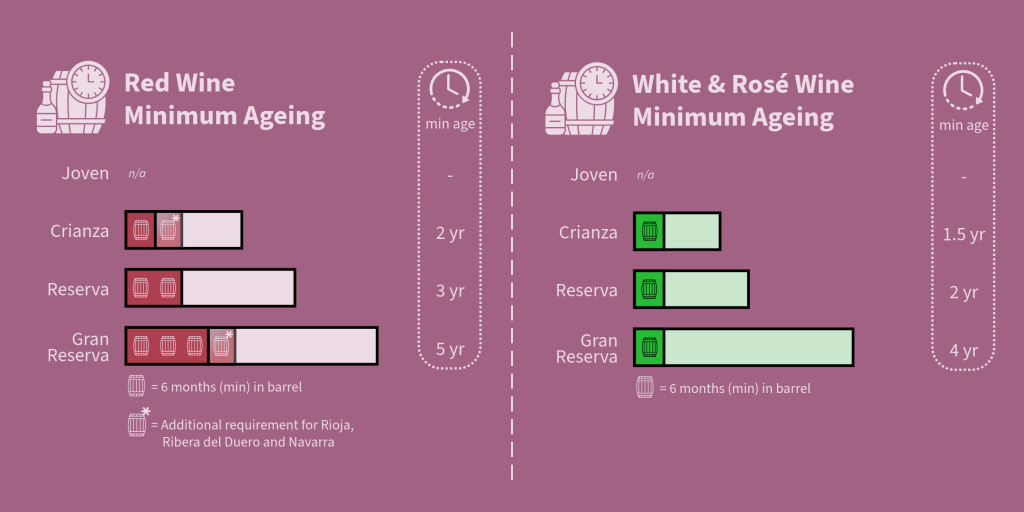
Whilst regions are important, with some regions classified more highly than others (more on this later), there is a clear hierarchy within each region around ageing of wine. You’ll likely have seen this on a bottle of Rioja without necessarily realising what it meant – ‘Gran Reserva’ isn’t just added to give the wine label a bit of flair! These are protected terms and tell you how much time the wine has sat in barrel or bottle before being released:
But why is this important?
Certain wine flavours only tend to appear with oak contact and with age, the label will give you a hint as to what flavours you’ll get in the glass. You’ll also get an idea of style, as wines marked ‘Joven’ (or unlabelled) tend to be on the lighter fruity end, but may have higher tannin, versus ‘Gran Reserva’ which can be quite savoury but tend to be softer and smoother.
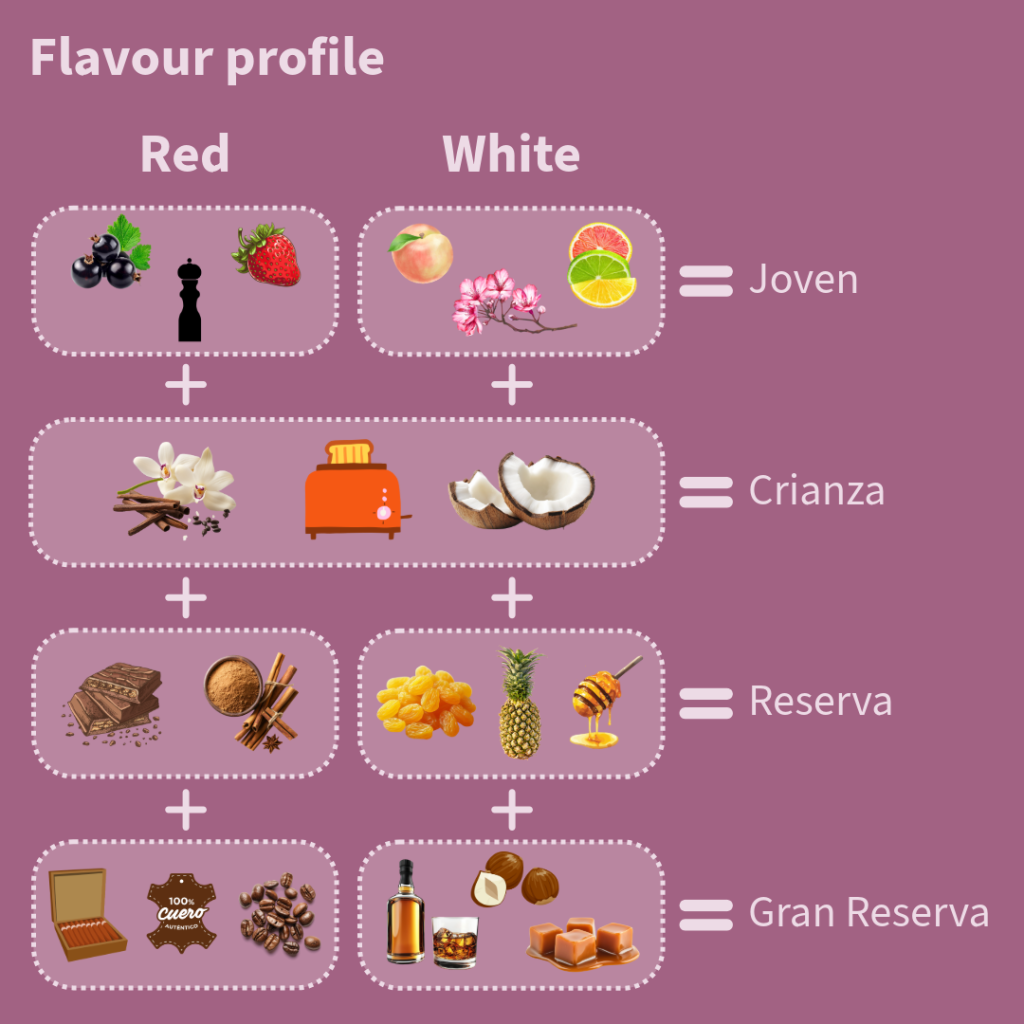
Whilst any two producers are likely to have very different styles, the above is a good rule of thumb – once you identify the ‘level’ of ageing that you prefer, it becomes easier to keep hitting the same sort of texture and flavour.
Note you’re unlikely to see ‘Joven’ on a bottle, but if you don’t see one of the above terms, then you’re likely to have a fruity and easy-drinking style on your hands.
Two grapes are better than one
Many of Spain’s most famous regions will not show the grape on the bottle. This is often because it will be a blend of two or more grape varieties! Whilst winemakers are focused on ageing potential of their wines, another factor they can play with in the winery is the blend of grape varieties – this allows them to mix in several characters to deliver the desired outcome.
For example, red Rioja is typically a blend of Tempranillo and Garnacha (potentially with other varieties thrown in). Tempranillo is intense, spicy and high in tannin, whereas Grenache is more mellow and warm with lower tannin. A blend that is more weighted towards Tempranillo is likely to be more alcoholic, drying and harsh when freshly made, lending itself to longer ageing (perhaps Reserva or Gran Reserva); a Garnacha-heavy blend is likely to be lighter and smoother, so perhaps more suited to a Joven or Crianza style.
The DOP system
The Spanish classification system for wine is known as the Denominación di Origen Protegida (‘DOP’) and enshrines key regions and winemaking styles in law. These rules determine the grapes that can be used in production, as well as the techniques that winemakers can (or perhaps must) use.
The more generic regional label is IGP (Indicación Geografica Protegida) or VdlT/VT (Vino de la Tierra) which is more flexible on winemaking style and grape varieties, but tells you that the grapes have been grown in the specified region.
There are four stages in the DOP hierarchy, split predominantly into DO regions (Denominación di Origen) and the more prestigious DOCa/DOQ regions (Denominación di Origen Calificada/ Denominació d’Origen Qualificada). There are only two regions in this category – Rioja DOCa and Priorat DOQ.
More entry-level wines are classified as VdC/VC (Vinos de Calidad, or ‘wines of quality’).
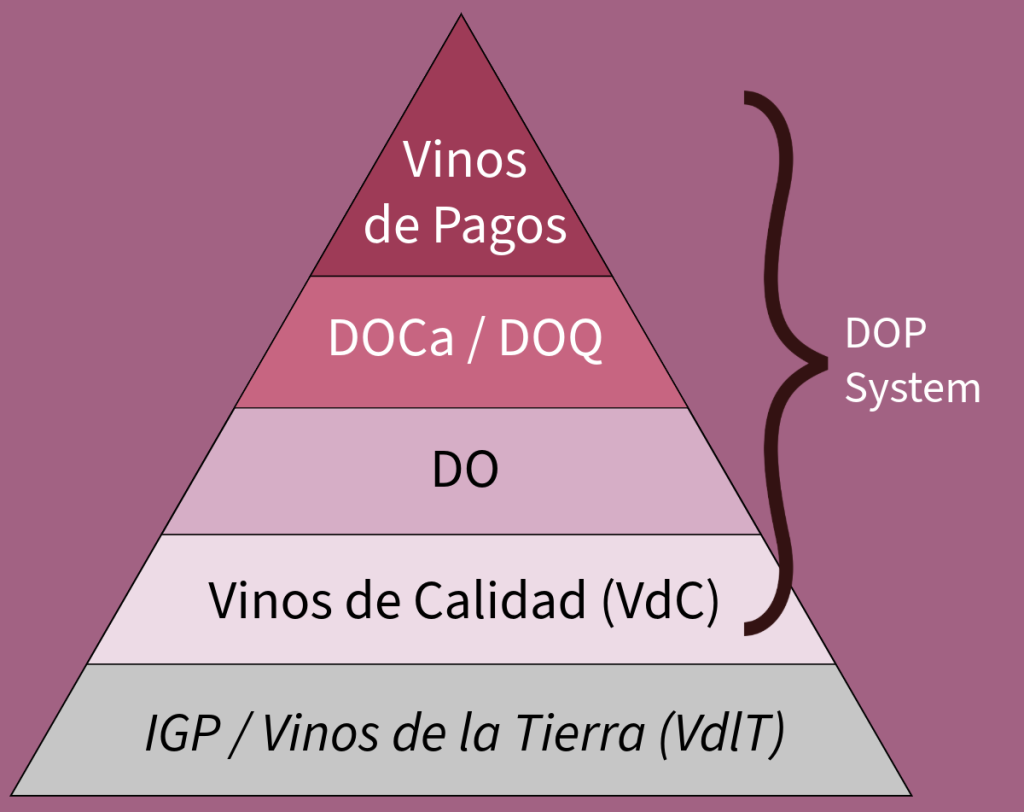
Vinos de Pagos (single vineyard wines) are also likely to include the DO or DOCa/DOQ label to show you which region they are from. These are the best of the best, so expect complex wines which won’t hit their peak for at least a couple of decades!
Wine regions across Spain
Whilst Central Spain is very hot, and most of Spain experiences hot summers, there is still climate variation across the country producing wines in a variety of styles.
Spain’s major wine regions tend to either hug the coastline or along major river valleys (the water having a cooling effect and making summers less intense). As a general rule, the North produces lighter style white and red wines, most of which are likely best drunk within a couple of years from their vintage date. Central Spain produces more intense wines which are likely to have spent a long time in barrel, and the South is more famous for production of fortified and sweet wines (sherry and vermouth).
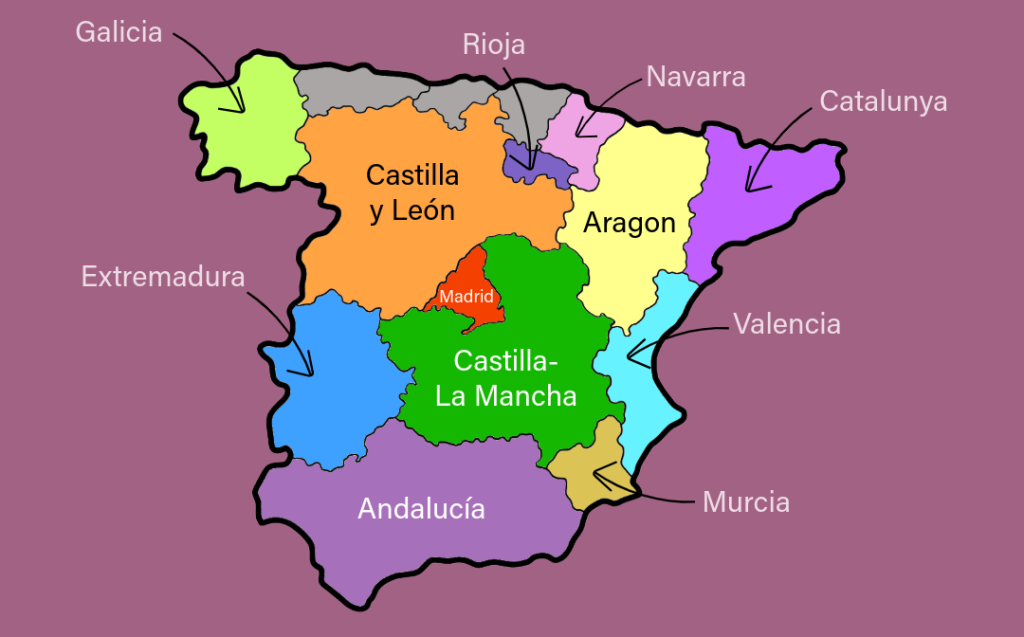
Here’s a quick rundown of wine styles you’re likely to find in each region – but bear in mind that, as with everywhere else, there will be huge differentiation within regions too.
Northwest Spain (Galicia, León)
In Northwest Spain the weather is cool and wet, producing light, refreshing white wines which pair excellently with seafood.
Galicia is home to one of Spain’s most famous white wine varieties: Albariño. Rías Baixas DO is the most famous region.
Lesser known is the Mencia grape, used to make light and fruity red wines which can be drunk slightly chilled. and Bierzo DO (famous for light red wines made from Mencia).
North-Central Spain (Rioja, Navarra, Castilla y León)
Here the weather is fairly hot, so the best wine growing regions tend to sit along river valleys. Expect intense oaked reds, floral white wines and fruity rosé.
Central Spain is home to Rioja DOCa, arguably Spain’s most famous wine region, and its biggest wine export. Both red and whites from Rioja are likely to have had some oak ageing.
The nearby region of Ribera del Duero DO in Castilla y León produces similar intense wines that are best aged in barrel. Rueda DO is better known for floral and fresh white wines, made from Verdejo and Sauvignon Blanc.
If you’re a fan of rosé (known as Rosado in Spain) Navarra DO is the place to visit – though don’t be put off by the intense deep colour! Whilst most may associate deep pink reds with sweeter wines, these tend to be dry and fruity. Red wine from Navarra tends to be similar in style to Rioja.
East Spain (Catalunya, Murcia, Valencia)
Another hot region but moderated slightly by the Mediterranean. The best vineyards here tend to be in the hills where altitude and sea breezes can keep the vineyards cool. Look here for sparkling wine and easy drinking wines along the coast, or intense reds from inland regions.
Penedès DO in the northeast is the heartland of Cava DO. This is Spain’s answer to Champagne – made in the traditional method, but using local grape varieties like Xarel-lo and Parellada.
If you’re a fan of full-bodied red wines, try Priorat DOQ – the tough rocky landscape, intense sunlight and low rainfall culminate in very concentrated flavours, high alcohol and high tannin.
Valencia DO and IGP Murcia along the east coast produce very good value wines, including sweet wines made from muscat.
South-Central Spain (Extremadura and Castilla-La Mancha)
Castilla-La Mancha is a hot region which produces a lot of entry-level wines. Expect simple, easy-drinking red and white wines.
Extremadura is more famous for its Iberico ham, but also produces rustic red wines (mostly Tempranillo) and fruity, lively white wines. It is less well-known as a region so you can find excellent value! There is also a small amount of Cava DO production here.
Southwest Spain (Andalucía)
This part of Spain is hot and probably better known as a tourist destination for Brits – the resort town of Marbella!
Andalucía is home to Jerez DO, the birthplace of Sherry. It sits on the southernmost point of Spain facing out to the Atlantic, with the cooling breezes making it perfect for making and maturing fortified wine.
Málaga DO is also known for sweet wine production, notably Vermouth.
Where next?
Once you’ve got your head around the ageing hierarchy of Spain, congratulations! You have now mastered the four biggest ‘Old World’ producers.
Most other regions have adopted some form of labelling terminology from France, Germany, Italy or Spain. Just bear in mind that the rules might not be so well-defined when you leave the heavily regulated space of ‘Old World’ wine!
Glossary
Local names for international grapes
- Cariñena – Carignan
- Garnacha – Grenache
- Mazuelo – alternative name for Cariñena/Carignan
- Monastrell – Mourvèdre
- Moscatel de Valencia – Muscat of Alexandria
Regional names for local grapes
- Cencibel – Castillan name for Tempranillo
- Macabeo – named used for Viura in Rioja
- Ull de Llebre – local name for Tempranillo in Penedès
Spanish wine terms
- Blanco – a white wine.
- Crianza – literally “Nurturing”; indicates that a wine has had a minimum ageing period in oak barrels and in bottle. Red wines: minimum 2 years aged, at least 6 months of which in oak (or 12 in Rioja, Navarra and Ribera del Duero). White & Rosé wines: minimum 1.5 years aged, at least 6 months of which in oak.
- DO – Denominación de Origen, a quality assurance label confirming the wine is from a recognised region and produced under strict rules (e.g., restrictions on grape varieties, winemaking style and ageing).
- DOCa – Denominación de Origen y Calificada, a superior quality assurance label confirming the wine is from a top wine region and produced under strict rules.
- DOP – Denominación de Origen Protegida, the Spanish premium wine classification system. This system includes VdC, DO, DOCa and VdP.
- DOQ – Denominació d’Origen Qualificada, an equivalent of DOCa in the Catalan language, found only in the region of Priorat in Catalunya.
- Espumoso – a sparkling wine.
- Espumoso Gran Añada – literally “Great Year”; this indicates a vintage sparkling wine, produced in the traditional (Champagne) method, with a minimum ageing requirement of 3 years in the bottle. A very complex and elegant style of Spanish sparkling wine.
- Espumoso Reserva – indicates a sparkling wine, made with the traditional method, with at least 2 years ageing in the bottle to produce a complex sparkling wine.
- IGP – Indicación Geografica Protegida, a broad regional label but still assures you that grapes have only come from the designated wine region.
- Genérico – literally “Generic”; means that the wine does not have any ageing requirements (equivalent to Joven). Likely to be easy drinking in style.
- Gran Reserva – indicates that a wine has spent a long time in barrel and bottle before being sold. Red wines: minimum 5 years aged, at least 18 months of which in oak (or 24 in Rioja, Navarra and Ribera del Duero). White & Rosé wines: minimum 4 years aged, at least 6 months of which in oak.
- Joven – literally “Young”; the wine is likely to be easy drinking in style with little to no ageing.
- Reserva – indicates that a wine has spent a reasonable time in barrel and bottle before being sold. Red wines: minimum 3 years aged, at least 12 months of which in oak. White & Rosé wines: minimum 2 years aged, at least 6 months of which in oak.
- Rosado – a rosé wine
- Tinto – a red wine
- VdC/VC - Vinos de Calidad, or “wines of quality”, indicating an entry-level wine but still within the DO classification system, meaning that it must meet the growing and winemaking rules from that region.
- VdlT/VT – Vinos de la Tierra, or “wines of the land”, used interchangeably with IGP. This generally indicates entry level wines. VdlT regions are much larger, meaning grapes can be sourced from a wider area, and there are few restrictions on wine production.
- VdP/VP – Vinos de Pagos are estate wines or single-vineyard wines, indicating a wine of outstanding quality. Expect the best that Spain has to offer!