Old World vs New World
"Old World" and "New World" are generic descriptors in the wine trade to distinguish between 'historic' wine producing countries versus those whose winemaking expertise evolved later. The language is quite reductive and falling out of favour in wine circles, but what is the difference?
The Old World traditionally refers to historic wine producing countries (read: European countries) that carry a lot of tradition and regulation in their winemaking. The main countries we think of here are Austria, France, Germany, Italy, Portugal and Spain, but this includes lower-volume wine producers with extensive winemaking history like Georgia, Hungary, Israel, Lebanon and Romania (amongst others). The New World includes everything else, including winemaking giants like Australia, South Africa and the Americas.
In practice "Old World" is used more poetically to refer to winemaking done in a traditional style. This usually means more rules (both in terms of grape selection and winemaking technique) and often is accompanied by confusing labelling terms.
New World, on the other hand, implies a bit more of a 'gung-ho' approach to winemaking - winemakers can use whichever grapes they want and do whatever they want (within reason) to produce the wine!
Why can't I see a grape on the label?
Old World comes with a lot of tradition, so wine labels from these regions can be much harder to understand. Often you won't find the grape listed on the bottle, so how are you supposed to know what to drink?!
I like to think of Old World wines as being more like 'brand names'. If you're an die-hard Pepsi-Max drinker, then a Coca-Cola might not cut it... similarly, you might like a crisp light Chablis but hate a heavy, oaky white Burgundy - even though they're made from the same grape (Chardonnay).
Two white wines from Chablis will likely taste relatively similar, but if you try two different Australian Chardonnays they could be opposite ends of the spectrum!
In general, these wine labelling terms arose to help consumers identify quality and consistency. What is fascinating is that each region's definition of quality is different, and it is this determination of quality that dictates what appears on your label.
Marks of quality
France
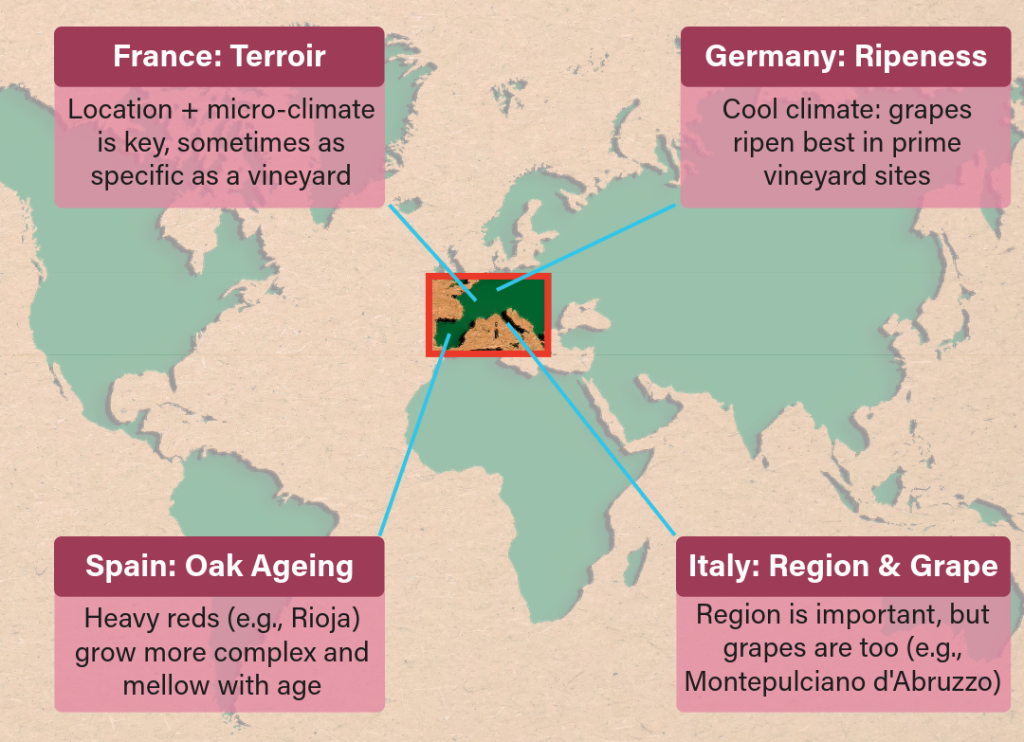
In France, 'quality' is dictated by the place, not the grape. This is often referred to as 'terroir' - the unique combination of soil, terrain and micro-climate that is found in a given location. However, 'quality' in French wine doesn't just stop in the vineyard - how a wine is made is almost as important. Most traditional French regions have very strict rules about what a winemaker can and can't do to produce their wine.
Wine labels in traditional regions like Bordeaux and Burgundy will rarely include the grape, as (as far as the winemaker is concerned) all you need to know is where it's come from, and that will tell you what the wine will taste like. This makes sense; a Sauvignon Blanc can taste wildly different depending on where it's grown, whereas a Sauvignon Blanc from Sancerre (just labelled 'Sancerre') will typically be light, crisp and smoky in character.
Germany
Germany is a cold country by winemaking standards. This makes it hard to ripen grapes unless they are grown in the best places: those with slightly warmer micro-climate or better sun exposure. The German labelling system has evolved with this in mind, with label terminology indicating how much sugar is in the grapes at harvest time. This classification doesn't necessarily align perfectly with wine sweetness, although it is indicative (and I'll give you some tips when we dive into the world of German wine in a few weeks). It's my favourite labelling system as it includes some lovely compound words that are as hard to remember as they are to pronounce!
In Germany you usually will find the grape variety on the label, though this isn't always helpful as these will be local grapes that are perhaps less familiar than international varieties, or the Germanic name for otherwise familiar grapes. Spätburgunder (literally: "late Burgundy") is the local name for Pinot Noir (the hero red grape of Burgundy), for example.
Interestingly, the rules on German wine labels is changing for wine produced after 2025 (yes, even traditions can change!) to make it more consistent with other regions. More on this in our German wine article to come!
Spain
Unlike Germany, Spanish winemakers have little problem ripening their grapes. In fact, the problem is the reverse: lots of sunlight means grapes with higher levels of sugar (meaning more alcohol after fermentation) and often higher levels of tannin. As a result, much of traditional Spanish winemaking revolves around ageing of wine in oak barrels to help soften these fiercer characteristics, and the labelling system has evolved accordingly.
Historic wine regions like Rioja won't tell you which grapes they use, but the labels will tell you how much time the wine has spent in a barrel.
Italy
Italy as we know it has only existed since the mid-19th century; before that, it was a collection of autonomous states and regions. That is immediately apparent when you look at winemaking in Italy, as each region has its own labelling quirks and even different names for the same grapes!
However, one theme that often comes up with Italian wine is the partnership of grape and place: many wines will be labelled with both the grape and the region. For example, Montepulciano d'Abruzzo is made from Montepulciano grapes grown in the Abruzzo region. Other regions follow the French system of labelling only by place. For example, Tuscany is famous for Chianti, which is mostly made from the Sangiovese grape but wines from this region will almost never mention the grape variety and simply label the bottle as a Chianti.
New World labelling
The New World has far fewer rules when it comes to winemaking. Most commonly, bottles will be labelled with both the region and the grape variety. This will tell you the majority grape(s) used in production, but this doesn't necessarily need to be 100% accurate - in Australia at least 85% of the wine must be made from the stated grape, but in the USA this is only 75%. That means that a US Cabernet Sauvignon could be a blend of up to 25% from other grapes!
Most wine regions around the world have adopted terminology from the Old World way of doing things. Many have their own defined regions that mirror the French appellation (regional) system, for example, American Viticultural Area (AVA) in the USA, Vintners' Quality Alliance (VQA) in Canada and Denominación de Origen Controlada (DOC) in Argentina.
You'll sometimes find other labelling terms being adopted: it's common for South American wines to include Spanish labelling terms like "Gran Reserva" to indicate a wine has spent longer in oak barrels (though there's often no legal requirements underpinning the term, unlike in Spain!).
The general principle here is more like a list of ingredients, but the style of the wine is entirely up to the winemaker. Thankfully, the winemakers are a helpful bunch - you're much more likely to see a description on the back of a New World bottle to tell you what flavour and style to expect from the wine!
Getting behind the label
Over the next few blog posts, I'll cover off the main wine-producing regions with the most confusing wine labelling systems, and give you a handy guide on how to interpret these.